
LaGrange Criminal History Checks
Start a LaGrange criminal record check by deciding whether the event was a police contact, a city citation, a jail booking, or a filed county charge. The city has separate police-record and municipal-court channels. Older city court files add an Archives route, while State and Superior Court cases belong to the Troup County clerk.
- For an incident or arrest made by LaGrange Police, use the police-specific records link rather than the city's general request form.
- Give the requester name, contact details, date range, location, report number if known, and a focused description of the LaGrange record.
- For a city citation or ordinance case, contact LaGrange Municipal Court and use the date printed on the citation.
- For a county jail booking or filed misdemeanor or felony, follow the Troup County jail, State Court, or Superior Court channel.
- For self-review of a Georgia history, use a local law-enforcement GCIC channel; authorized fingerprint checks go through GAPS/Fieldprint.
LaGrange Police Requests Use a Separate Link
LaGrange's citywide open-records page provides a general form, but it expressly routes police records to a separate police link. That distinction prevents a common delay. An incident report, police arrest report, or similar LaGrange Police record should begin with the department's own channel rather than a general city-hall submission.
The general form asks for the requester's name, date, street address, email, phone, access choice, and a detailed record description. A requester may choose inspection and copying or request copies. Precise dates, locations, names, and report numbers help the city locate the correct LaGrange material.
This image comes from the official LaGrange open-records source.
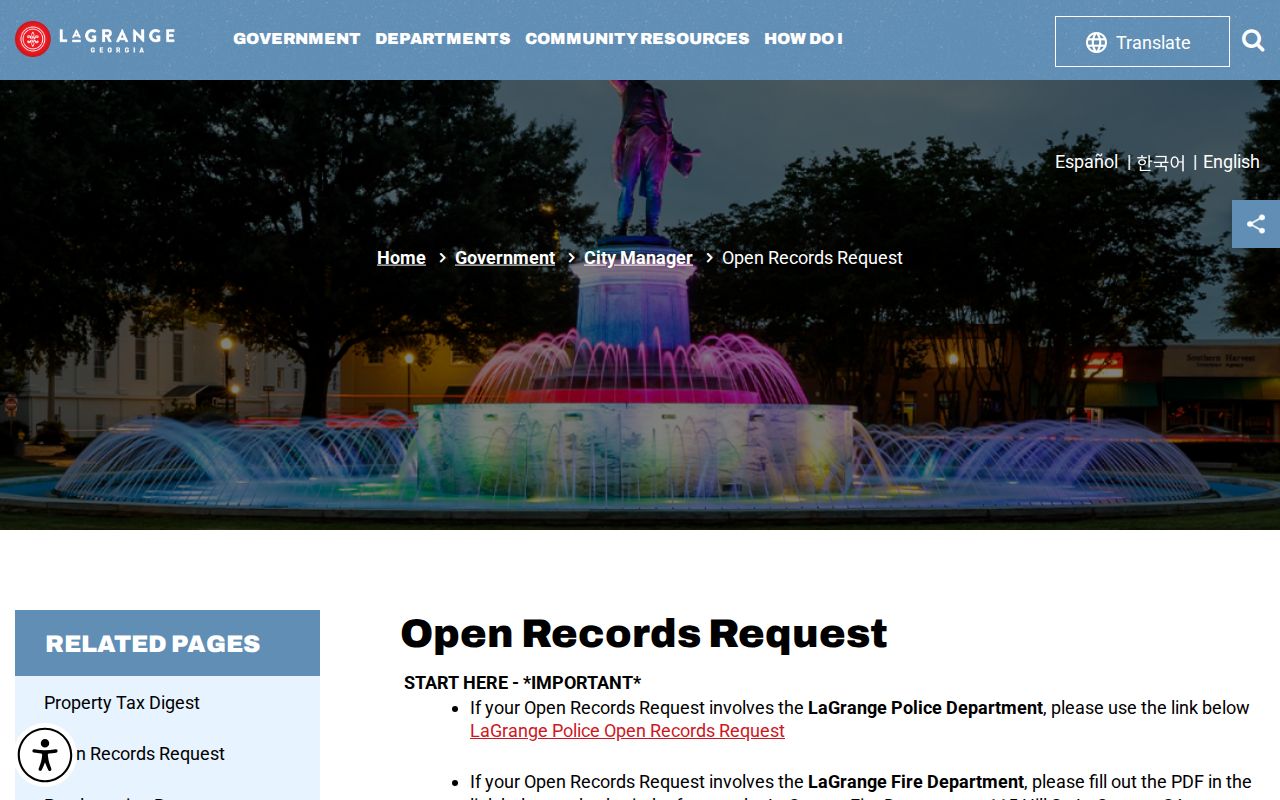
The visible routing reinforces that police requests and general city requests do not share one intake path.
Records at the LaGrange Police Department
LaGrange Police Department operates at 100 West Haralson Street, LaGrange, GA 30241. The department publishes 706-883-2603 and 706-883-2606, along with officeofchiefofpolice@lagrangega.org, for nonemergency contact. Its official page links open records, annual reports, press-release signup, tip411, and fine payment.
The department holds its own incident and arrest material. Ask for the exact report rather than an undefined criminal history. Identify the date, place, people involved, report type, and incident number when known. Active-investigation details, juvenile material, victim identifiers, medical information, and confidential identifiers may be withheld or redacted.
The image below is sourced from the official LaGrange Police page.
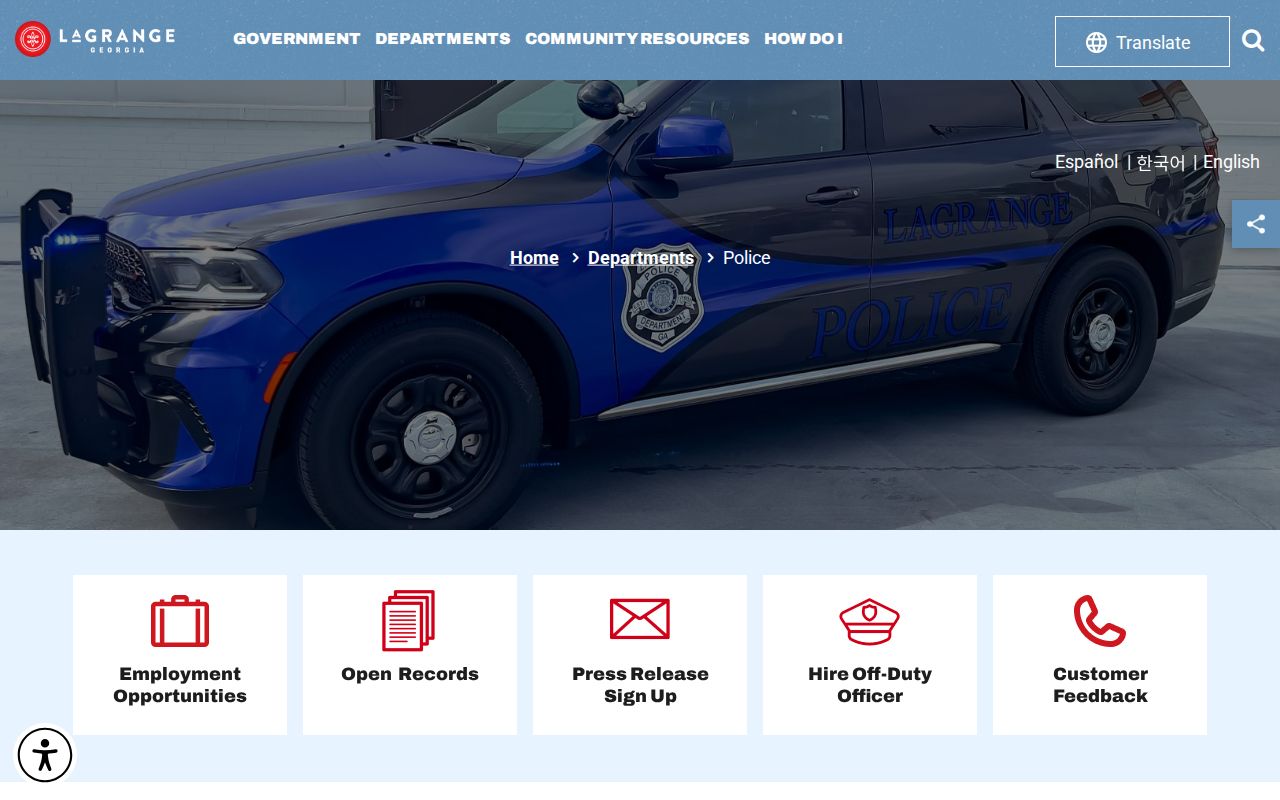
That department page is the most direct starting place for current LaGrange police links and contact details.
LaGrange Police Reports and Troup Bookings Differ
A LaGrange Police report describes the reported event and the department's action. If an arrest leads to jail intake, Troup County Jail creates a separate booking record with a booking number, booked allegations, bond, dates, and custody details. The two records answer different questions and may be held by different custodians.
| LaGrange Police Record | Troup County Booking |
|---|---|
| Incident number and narrative | Booking number and intake time |
| Investigating or arresting officers | Arresting agency and booked charges |
| Requested through LaGrange Police | Requested through sheriff or jail custodian |
| May exist without jail intake | Shows custody, not conviction |
Booking and Arrest Records in LaGrange
City arrests involving county-level charges ordinarily lead to Troup County Jail, then a Magistrate Court first appearance and a State or Superior Court case if charges are filed. No verified official public county booking roster was found. Call the jail at 706-883-1729 and ask for current custody or the releasable booking identifier, then contact LaGrange Police for the agency report.
A negative current-custody answer does not prove that no LaGrange arrest occurred. The person may have been released, transferred, or never booked. Follow the incident number into the agency record, then use the court clerk to determine whether a prosecutor filed a charge.
From a LaGrange Arrest to Ridley Avenue
A LaGrange case can move quickly among nearby offices. Police headquarters is on West Haralson Street. The Municipal Court is at 208 Ridley Avenue. The Troup County Government Center, which houses the Clerk of Superior and State Courts, is at 100 Ridley Avenue. Physical closeness does not merge the files.
Municipal Court handles city-level matters. State Court generally handles misdemeanor criminal cases, and Superior Court handles felonies. Magistrate Court issues warrants countywide and conducts first appearances for jailed accused people. For a LaGrange felony, the city police report remains with LPD while the filed charge and outcome move through county court.
The LaGrange Municipal Court File
LaGrange Municipal Court is at 208 Ridley Avenue, LaGrange, GA 30240, with 706-883-2026 as the published court number. The official court site states that sessions are held Tuesdays at 1:30 p.m., while the date and time for an individual matter appear on its citation. Call the clerk when the citation and web information differ.
| Court | LaGrange Municipal Court, 208 Ridley Avenue |
|---|---|
| Matters | City ordinance and traffic matters within municipal jurisdiction |
| Lookup | Court clerk by phone or counter; no verified public name-based docket search |
| File contents | Citation, court date, plea, disposition, and financial entries as applicable |
| Copies and fees | Confirm current availability and cost with the court before ordering |
LaGrange Ticket Payment Is Not a Record Search
Government Window is linked by the city for citation payments. It displays Traffic Tickets, the court address and phone, vendor help, and payment controls. It is not represented as a comprehensive LaGrange criminal case database or a name-based search.
Use the payment interface only for the citation task it supports. A reader seeking a disposition, docket entry, or copy should contact the Municipal Court clerk. A county misdemeanor or felony requires the Troup County clerk rather than the city payment screen.
How LaGrange Records Reach the County
A LaGrange arrest report begins with the police department. A fingerprintable county booking creates an arrest cycle that can be sent to the Georgia Crime Information Center. Prosecutors decide what charge proceeds, and State or Superior Court records the filed case and final result. Reporting agencies later send dispositions to GCIC.
Record flow: LaGrange Police Department › Troup County Courts › Georgia Bureau of Investigation, Georgia Crime Information Center
Recent facts are most likely with LaGrange Police and the jail. Filed charges and outcomes are with the court. A person's own Georgia history may reveal whether GCIC attached the reported disposition to the arrest cycle. Each source should be checked on its own terms.
LaGrange Municipal Records Split at 2020
The live Municipal Court keeps LaGrange municipal files from 2020 forward. Troup County Archives holds LaGrange Municipal Court records from 2009 through 2019. Archives staff need the defendant name and disposition date, so an archive request may require a first call to the court for an index clue.
This local split makes date the key routing fact. Send a current LaGrange disposition request to the Municipal Court. For a 2009 through 2019 file, use the Troup County Archives government-record request. Older Superior and State Court criminal holdings have their own year ranges and case-number rules.
Use Dated LaGrange Police Annual Reports
LaGrange Police publishes annual-report links and displays large activity counters on its department page. A counter without a clear reporting period can be mistaken for a current annual total. Use the named annual report and state its year whenever a LaGrange crime or activity figure is cited.
The Census 2020 count of 30,858 makes LaGrange the largest incorporated city in Troup County and the county seat. Population context explains the volume and central role of its city agencies, but it does not prove that any one person has a police or court record.
LaGrange Record Access Rules
Georgia law begins with the correct custodian. LaGrange Police handles its police material, Municipal Court handles city case records, and the Troup clerk handles filed State and Superior Court cases. Agencies may redact protected portions while producing separable public material. A three-business-day response duty addresses status and timing; it does not guarantee that a large request is completed in three days.
Key Statutes:
Georgia Open Records Act, O.C.G.A. §50-18-71 sets request, response, inspection, copy, and permissible-cost rules.
O.C.G.A. §35-3-34 governs dissemination of Georgia criminal-history information and distinguishes repository records from open court files.
O.C.G.A. §35-3-37 governs qualifying record restriction and its effect on ordinary public access.
When a LaGrange Disposition Date Is All You Know
Begin with LaGrange Municipal Court if the matter was a city citation or ordinance case. Give the full legal name, approximate year, and known disposition date. Ask whether the court still holds the file or whether the 2009 through 2019 Archives range applies. If the matter involved a misdemeanor or felony filed outside municipal jurisdiction, call the Troup County clerk instead.
A disposition is more reliable than an arrest label when the goal is to understand how a matter ended. Compare the court outcome with any LaGrange Police or booking record, especially when a booked allegation changed, was dismissed, or never became the filed charge.
When identity is uncertain, do not rely on a shared name alone. Use a case number, citation number, date of birth where lawfully displayed, incident number, and filing year to keep one LaGrange record from being confused with another. The clerk or records custodian can also explain which identifier is needed for a copy request.