
Criminal Court Cases in Troup County
Troup County Superior Court hears felonies as part of the Coweta Judicial Circuit. State Court handles misdemeanors and traffic matters within its jurisdiction. Magistrate Court issues arrest warrants across Troup County, holds first appearances, and conducts probable-cause or committal hearings. It does not decide felony guilt. LaGrange, West Point, and Hogansville municipal courts keep their own ordinance and traffic or citation records. Picking the wrong custodian is one of the fastest ways to miss a case.
The Clerk of Superior and State Courts receives filings, maintains the live court record, provides public access, and collects court funds. The office is at 100 Ridley Avenue in LaGrange and uses the county main number, 706-883-1610. Ask whether the matter is in Superior or State Court and whether the clerk can supply docket data, an uncertified copy, or a certified final disposition.
The county clerk’s official page shows the office responsible for Troup County court cases. The source view below helps identify the correct local custodian.
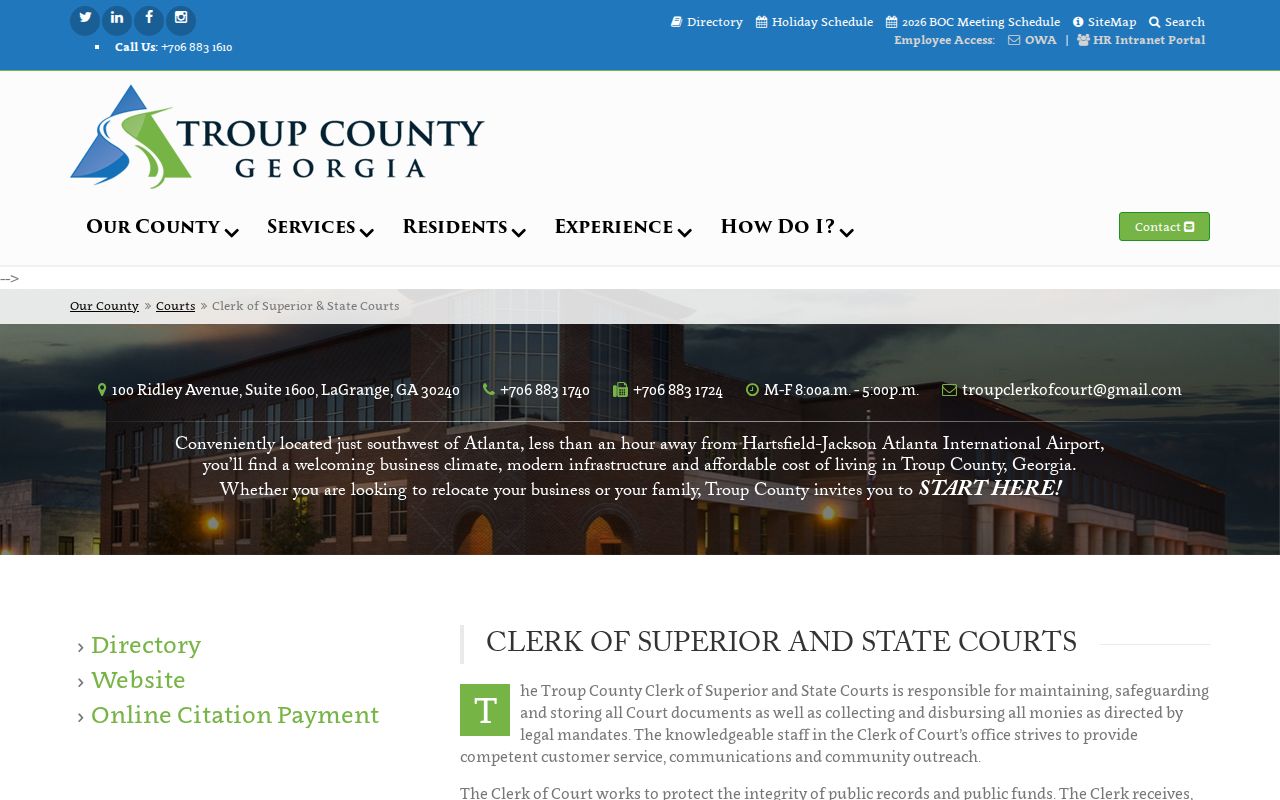
Use the clerk after an online provider returns no result, lacks a document image, or leaves the disposition unclear.
Troup County Court Custodian Map
The filed charge controls where a Troup County criminal case proceeds. A felony accusation or indictment belongs with Superior Court. A misdemeanor accusation generally belongs with State Court. A warrant or first-appearance record begins in Magistrate Court, even though the later prosecution may move elsewhere. City citations remain with the municipal court unless the matter enters a county trial court.
| Court | Criminal role | Contact point |
|---|---|---|
| Superior Court | Felonies, indictments, felony outcomes | 100 Ridley Ave.; 706-883-1610 |
| State Court | Misdemeanors and traffic cases | 100 Ridley Ave.; 706-883-1610 |
| Magistrate Court | Warrants, first appearances, committal hearings | County directory |
| LaGrange Municipal Court | City citations and ordinances | 208 Ridley Ave.; 706-883-2026 |
| West Point Court Services | Municipal citations | 706-645-3512 |
| Hogansville Municipal Court | City cases and dispositions | 600 E. Main St.; 706-637-8629 |
West Point crosses the Harris County line, so confirm both the city and county before requesting a court file.
Troup County Case Record Searches
The Georgia Judicial Council E-Access directory lists Troup State Court and routes users to a participating provider. It is a directory, not one complete statewide trial-court database. An account is required, and provider coverage, field labels, and document fees can change. A Troup County court case search should therefore pair electronic access with the clerk and Archives.
- Identify Superior, State, Magistrate, or a municipal court from the charge and event.
- Open E-Access, choose the participating Troup court, and follow the provider link.
- Search a full legal name or known case number, then narrow by filing year and case type.
- Read the docket for filed charges, hearings, disposition, and sentence instead of relying on the result label alone.
- Call or visit the clerk for missing images, certified copies, or a result that does not appear online.
| Field label | Type | Required | Notes |
|---|---|---|---|
| Court | Selection or link | Yes | Choose the correct participating court; Troup State is listed. |
| Party or name | Text | Provider-specific | Use the full legal name and reasonable variants. |
| Case number | Text | Provider-specific | Historical formats include 95-R-1234 and 10-S-1234. |
| Filing date or range | Date | Optional | A year helps separate common names. |
| Case type or status | Dropdown | Optional | Live options depend on the provider. |
| Search or reset | Button | Provider-specific | Confirm labels after the directory redirects. |
Older Troup County Criminal Cases
Troup County has a sharp live-record and archive split. Troup County Archives holds Superior Court criminal cases from the early 1800s through 1995. It holds State Court criminal files from 1989 through 2010. LaGrange Municipal Court records from 2009 through 2019 also sit there, while the municipal court keeps records from 2020 onward.
Archives staff need the case number before pulling a Superior or State Court file. Begin with the live clerk’s index. Historical examples show an R in a Superior file such as 95-R-1234 and an S in a State file such as 10-S-1234. For an archived LaGrange municipal matter, obtain the defendant name and disposition date. This search-first, retrieve-second sequence prevents a broad archive request that staff cannot index for the requester.
The Archives request page documents the Troup County court case year ranges and number requirement. Its source screen is shown below.
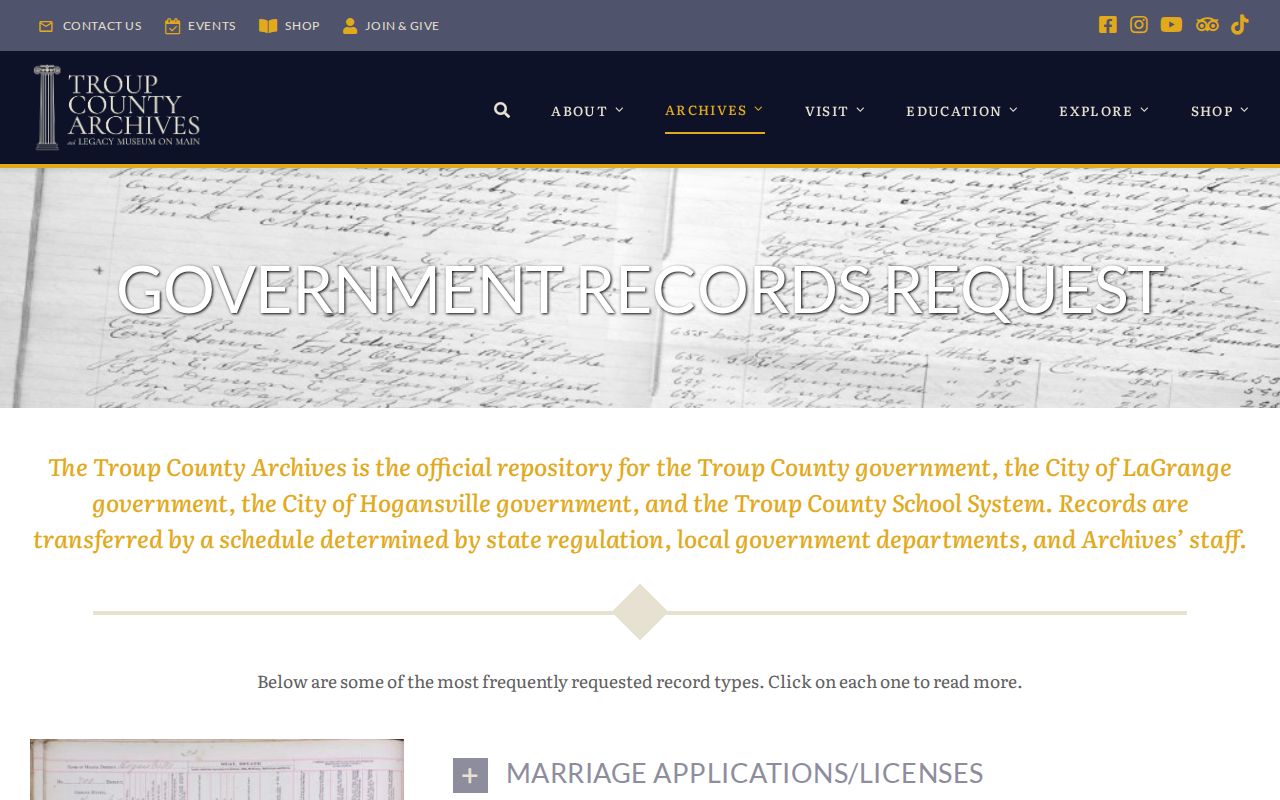
The archive is especially useful for genealogy, local history, and an old prosecution once the correct index key is known.
What a Criminal Case File Contains
A Troup County court file records what the prosecutor filed and what the court did. It differs from the jail’s intake record and from a GCIC criminal history. Check the actual charging paper, docket, judgment, and sentence before describing the outcome. Documents may not be online even when a provider shows the docket.
| Case number and court | Identifies the custodian, division, and local file. |
|---|---|
| Charging document | Shows the accusation or indictment, statute, and filed counts. |
| Docket entries | Chronology of filings, motions, orders, and court events. |
| Hearing dates | Arraignment, motion, plea, trial, and sentencing settings where recorded. |
| Disposition and judgment | Shows how each charge ended, including conviction, acquittal, dismissal, no bill, or nolle prosequi. |
| Sentence and conditions | Records custody, probation, fines, costs, restitution, and other terms imposed. |
| Document links | May appear through a provider, but availability and cost vary. |
Note: A name match alone is weak; compare the court, case number, filing year, and lawful identifiers shown in the record.
Troup County First-Appearance Records
After jail intake, Troup County Magistrate Court conducts the first appearance within its published 48-to-72-hour window, generally on Monday, Wednesday, and Friday morning video calendars. The hearing addresses counsel, probable cause or bail, conditions, and committal-hearing scheduling. It is an early step, not the final felony court file.
The Magistrate Court criminal-jurisdiction page documents its warrant and first-appearance role. The source image below ties the early court event to the later Troup County case route.
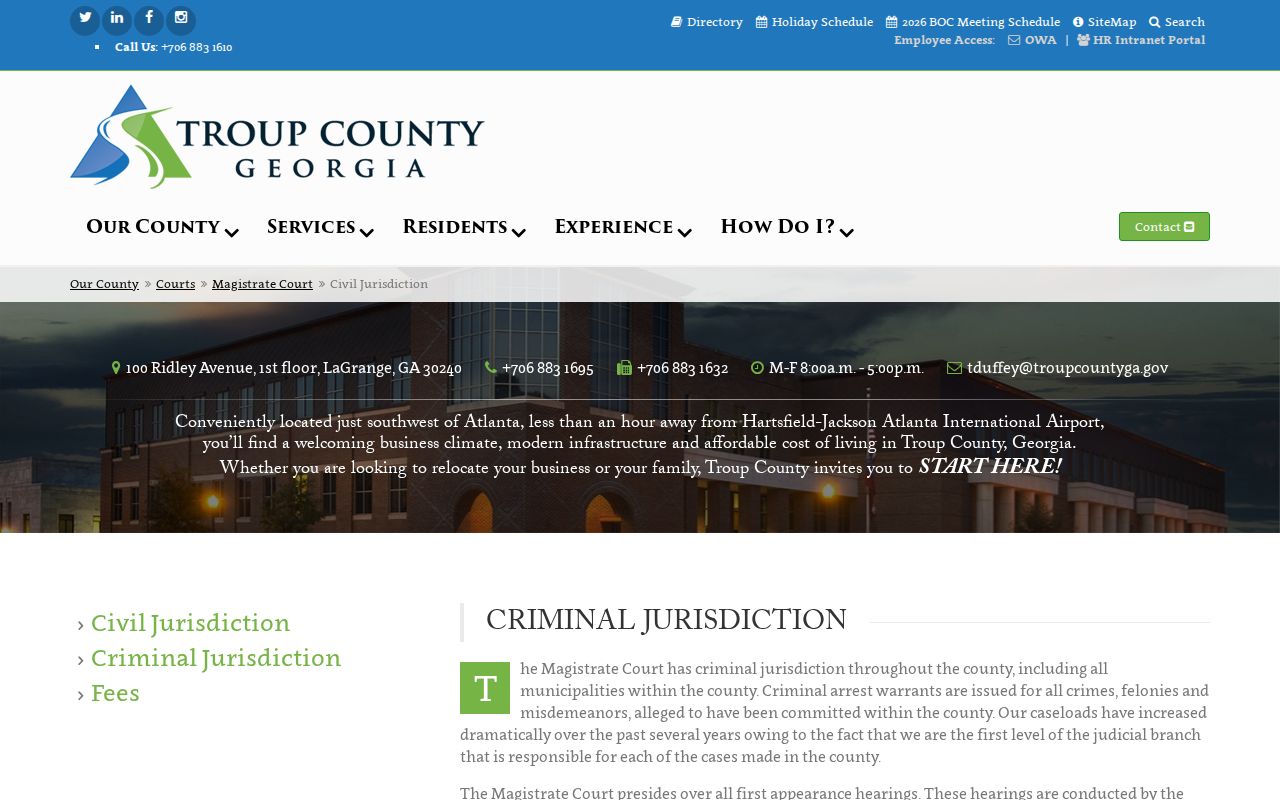
After review by the prosecutor, a felony may proceed by accusation or grand-jury indictment, while a misdemeanor generally goes to State Court.
Criminal Case Stages in Troup County
The route starts with an allegation, but the durable court record begins as charges are filed. Each count can change or end in a different way. Read the entries in order and then find the final judgment for each count. An appeal, if filed, adds another layer rather than replacing the trial-court file.
Case flow: Charges Filed › Arraignment › Pretrial › Plea or Trial › Disposition › Sentencing
Terms matter. An arraignment is the hearing at which the accused is advised of the charge and enters a plea. A nolle prosequi means the prosecutor formally chose not to proceed at that time. A dead docket suspends prosecution without a final adjudication. A no bill means the grand jury declined to indict. None of those terms should be relabeled as a conviction.
Troup County Mental Health Court
Troup County’s Mental Health Court is a named accountability track involving judges, prosecutors, defense counsel, probation, and treatment providers. The program requires at least 12 months for misdemeanor participation and at least 18 months for felony participation. It has no participant fee and uses local eligibility rules tied to residence, charge or probation, and serious persistent mental illness related to the charge.
The official program page publishes its application, calendar, handbook, and contact material. The source view below shows why a Troup County docket may include review events tied to a structured local program.

Program participation does not erase the need to read the filed charge, court outcome, and sentence in the clerk’s record.
Counsel in Troup County Cases
The county publishes separate public-defender procedures. State Court instructions call for picture identification, proof of household income, and a nonrefundable $50 payment by money order, cash, or cashier’s check. Personal checks and partial payments are not accepted. The displayed income table may age, so an applicant should confirm current eligibility figures directly.
The official public-defender page is preserved in the image below as a practical Troup County court case resource.

A defender’s file is not the public docket. For the public case history, disposition, or certified copy, return to the court clerk.
Access Rules for Troup Case Records
Georgia court records are generally open, but access is not absolute. Juvenile information, victim identifiers, medical material, active-investigation content, and sealed or restricted records may be withheld or redacted. Under the Georgia Open Records Act, an agency must address inspection or copying under the governing rules, identify a lawful basis for withholding, and provide segregable public portions when possible.
Online redaction does not prove the clerk’s paper file has the same public scope. If the provider lacks a Troup County criminal case, call the proper clerk with a full name, approximate year, court, and case number. Ask for the docket and requested documents as distinct items. For the broader record trail beyond filed court events, use the county’s criminal history overview to identify the arresting, jail, state, or corrections custodian.
Note: Record restriction in GCIC and sealing a court file are related legal steps, but one does not automatically complete the other.